01
ON!Track · Product Strategy · Vision 2030
From Asset Tracking to Operational Intelligence
A multi-year product vision connecting assets, transfers, services, field requests, gateways, warehouses, vans, and mobile workers into one role-aware operational system.
A multi-year direction the team can plan against — not a single feature, not a guaranteed revenue forecast.
This vision builds on the design value validated in Storage Assets: New Look 2025.

Role
Product strategy, UX vision, IA, prototyping
Horizon
2026 – 2030 roadmap influence
Business frame
Premium-tier expansion · CHF 300M 2030 modeled ambition
01A
Status
Status of this work.
Vision 2030 is a strategic product vision and roadmap-alignment artifact, not a shipped revenue result. It was created to connect validated workflow problems, customer evidence, role-based operating models, and long-term business ambition into a shared direction for ON!Track.
The CHF 300M figure represents a 2030 modeled ambition / target scenario. It should be read as a business framing device for strategic alignment, not realized revenue.
Strategic framing
Roadmap alignment · CHF 300M 2030 modeled ambition
A shared direction for evaluating product bets, not a financial-reporting claim.
02
Foundation
The shipped work that opened the strategic conversation.
Storage Assets: New Look 2025 was the shipped foundation behind Vision 2030. It took a recurring asset-list problem — vans, kits, storage assets, nested contents, status, selection, and transfer counts not matching what crews saw on site — and produced reusable list patterns the rest of the product could reuse.
As part of the broader ON!Track New Look release, this work contributed to revenue growth from CHF 72M to CHF 85M. It also created shared web and mobile patterns — clearer hierarchy, visible system state, reusable list primitives, and role-aware scanning — that the wider product could pick up.
That credibility mattered. It gave the design work a seat at the leadership table: first by solving a concrete operational problem, then by using the same validated principles to ask a bigger question — what if ON!Track could move beyond asset tracking and become a role-aware operational layer?
Foundation case study
ON!Track Storage Assets — New Look 2025
The shipped proof point behind Vision 2030: storage-asset visibility became one of the reusable experience foundations for a broader product narrative.
CHF 72M → 85M
FY24 → FY25 ON!Track ARR (contributed to)
+18% YoY
ARR growth the release contributed to
60%
Fewer manual entries at peak transfer [VERIFY: V3/S4]
~42%
Designer estimate of reusable-list effort saved [VERIFY: V4/S7]
View case study →
03
The Friction
The product had the data. Users still had to create the meaning.
Jobsite and warehouse teams were not missing data. They were missing role-specific operational meaning: what needs attention, who owns it, and what action should happen next.
01
Download a report
02
Crunch the data manually
03
Reconstruct context across modules, calls, spreadsheets, and messages
04
Gain insight after the fact

04
Research Evidence
Research that clarified where automation could help.
The research synthesis was used as a working input, not as the story itself. It helped us connect recurring jobsite questions to a smaller set of workflows where automation, role clarity, and better evidence could reduce manual follow-up.
Research posture
Keep the evidence close, but let the workflow story lead.
Field inputs, internal reviews, and product observations were synthesized into concept directions.
01
User journey map
Mapped how responsibility moves from needing a tool to providing it and assuring operational profitability.
02
Search, find & lost
Clarified how teams look for assets, verify last-seen evidence, and decide whether something is truly lost.
03
Inventory
Merged formal and monthly inventory: what is there, what is not there, what needs reconciliation, and how teams keep it current.
04
Asset allocation
Micro-level ownership: which asset belongs with which worker, location, cost center, or operational need.
Research Artefact Gallery
Four workflows, four confidence valleys.
The vision needed to scale across four complex, interconnected operational workflows. Rather than burying insights inside giant horizontal canvases, we identified the specific emotional valleys where confidence collapsed, turning each friction point into a concrete product feature.

Big picture
Click the full workflow map to inspect the connected system.
The zoomed-in view made the emotional valley legible. The full map kept the broader operating model visible for design, product, and engineering conversations.

Workflow 01
Search, Find & Lost
Workflow 02
Asset Allocation
Workflow 03
Formal & Monthly Inventory
Workflow 04
Asset Profitability
Research Workspace

Research Synthesis Repository

Workflow 01
Search, Find & Lost
Workflow 01
Search, Find & Lost
Workflow 01
Search, Find & Lost
04A
Alignment
How I led alignment.
This vision was not created as a solo design concept. My role was to turn fragmented product discussions, customer evidence, and roadmap pressure into a shared strategic narrative that PM, design, engineering, and leadership could evaluate together.
For Product and Business stakeholders
I connected recurring workflow problems to premium-tier differentiation, role adoption, and long-term product ambition.
For Engineering
I clarified product boundaries: ON!Track should become more proactive and intelligent, but it should not pretend to know the full project plan or become a project-management system.
For Designers
I translated the vision into reusable principles: role-based visibility, operational status over generic scores, linked-but-separate workflows, and evidence staying attached to the asset record.
For Leadership
I framed Vision 2030 as an iterative alignment artifact — a way to connect near-term roadmap enablers such as Field Request, Transfer Cart, Service, Smart Site, Driver Journal, and missing-asset investigation into one coherent product direction.
05
Vision Dashboard
A predictive, role-aware interface.
A role-aware command center connects inventory health, live asset signals, and location boundaries — then surfaces what matters before a user has to ask.
Previously · Reactive
01
Download report
02
Crunch the data
03
Gain insight
The user carries the analytical burden and often discovers risk only after assembling the evidence.
New Vision · Proactive
01
Built-in intelligence
02
See only what matters
03
Act on insight
No manual analysis required. The system understands the user’s role and goal, then proactively surfaces the right insight and next action.
06
Personas & Operating Models
The same tool questions behave differently by role and company size.
Synthesised from the 40+ customer interviews and internal solution-consultant reviews. The vision needed to work for both small specialist installers and large construction groups. In a solar or heating installation company, one back-office person may also act as warehouse manager while the site manager deals directly with workers. In a large contractor, responsibility splits across crews, foremen, jobsites, warehouses, and commercial operations. [VERIFY: V5 — confirm persona derivation source]

Persona 01
Need tool to perform job
Job site worker
Operating context
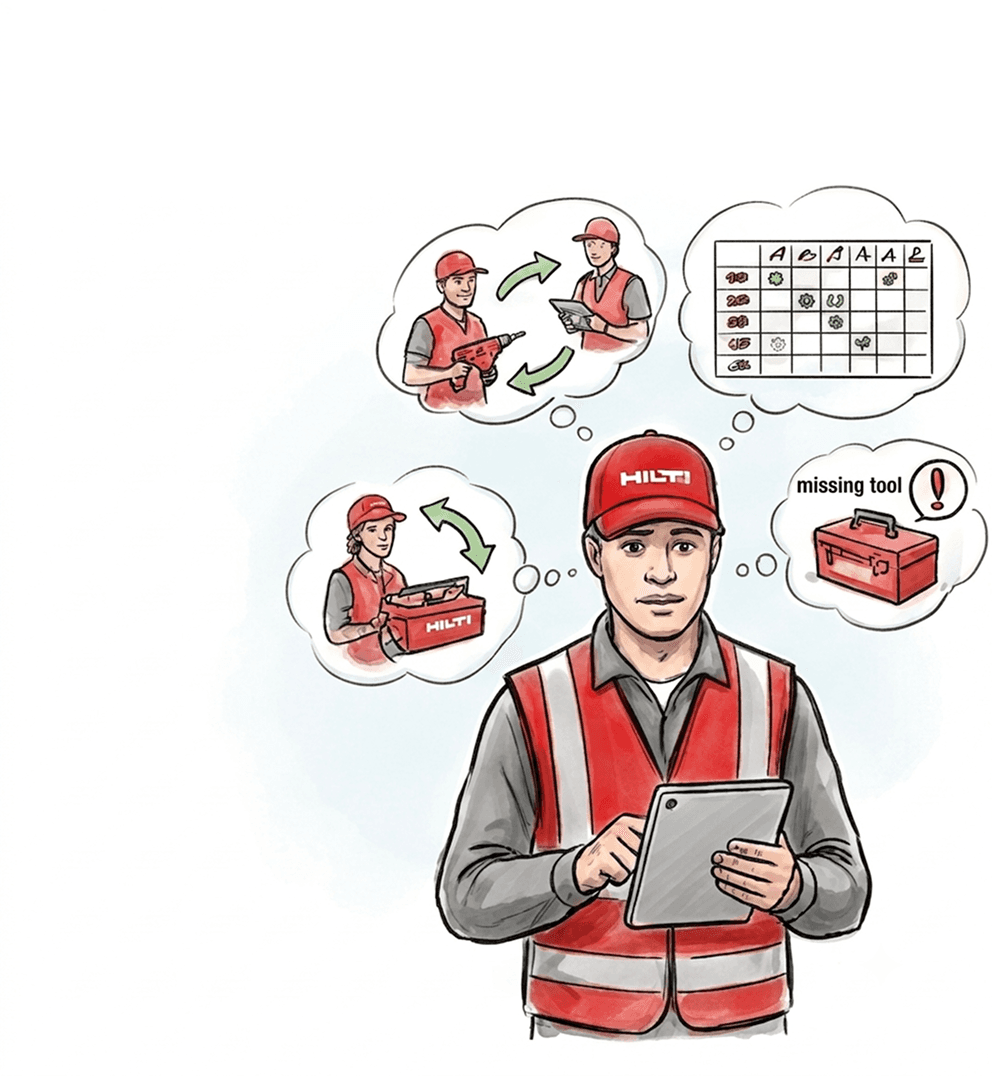
Owns a task, a kit, or a small group of tools while moving between vans, floors, and installation moments.
Human tension
They do not want to manage inventory; they want confidence that the right equipment is ready when the work starts.
Key question
Where is it? What is there? Is it operational, charged, certified, and available now?
What the product must support
Persona 02
Provide the tools for crew to perform job
Foreman / crew lead
Operating context
Manages the crew, sequences work, and makes sure the right tools are in the right hands.
Human tension
The day can fall apart quietly: one missing tool, one unclear handover, one repair nobody saw coming.
Key question
Who has what? Is anything missing, idle, broken, overdue, or blocking today’s work?
What the product must support

Persona 03
Control inventory for one or many locations
Job site / warehouse manager
Operating context
May run one jobsite, a local warehouse, vans, or several active locations depending on company size.
Human tension
They sit between field reality and system truth, trying to make inventory reliable without slowing teams down.
Key question
Is it there or gone? Can it move? Does it need service? Which location owns it next?
What the product must support

Persona 04
Assure profitability and allocation
Back-office / profitability manager
Operating context
Owns cost, utilization, charge-out logic, and whether equipment is allocated to the right project.
Human tension
Their pressure is commercial: lost, idle, or wrongly allocated equipment quietly erodes margin.
Key question
Is the asset within my operations or lost? Is cost allocated correctly? Do we own too much, too little, or the wrong mix?
What the product must support
Small specialist company
Solar, heating, and specialist installers compress roles.
The back office may also be the warehouse manager. The jobsite manager or foreman may coordinate directly with workers, vans, and customer appointments. The product must stay lightweight: fast find, simple requests, clear allocation, and minimal setup.
Large construction group
Responsibility separates across many locations.
Workers, foremen, site managers, warehouses, drivers, and commercial teams each need a different slice of the same asset truth. The product must preserve evidence, ownership, transfer history, and cost allocation across the whole network.
07
Design Decisions
The decisions that made the vision credible.
No readiness score
Field Request is not Transfer
Transfer Cart is staged movement
Role-based visibility
Asset owns last seen
Service overdue blocks work transfer
08
System Story
How the future system works.
09
Roadmap Influence
2026 to 2030 — an iterative alignment artifact.
2026
Foundation
Role-based visibility foundation, transfer-model cleanup, service lifecycle.
2027
Demand & movement
Field Request, Transfer Cart, mobile approvals.
2028
Smart Site
Smart Site, geofence creation, gateway coverage.
2029
Smart Inventory
Smart Inventory, Driver Journal, automated transfer evidence.
2030
Operational control at scale
Role-based operational control at scale and AI-assistant pilot.
This vision is intentionally iterative — not a fixed blueprint, but a strategic alignment artifact.
10
Business Impact Hypothesis
Modeling premium differentiation and the road toward a CHF 300M ambition.
The model was used to make the business conversation tangible: how role adoption, premium differentiation, and operational workflow value could support a 2030 ambition. It was not intended to forecast guaranteed revenue.
User outcomes
·
·
·
·
·
Product outcomes
·
·
·
·
Scenario assumptions
120 premium-upgrade candidates · 10% = 12 accounts · 20% = 24 accounts · 30% = 36 accounts. [VERIFY: V6 — source for 120 candidate pool]
Figures are illustrative and scenario-based — not realized revenue, committed forecast, or financial reporting.
11
Reflection
What this vision changed.
01
Reframed the problem
From “Where are my tools?” to “What needs action across the jobsite?”
02
Clarified the boundary
ON!Track remains asset and inventory management, not project planning.
03
Connected roadmap enablers
Field Request, Transfer Cart, Service, Smart Site, Driver Journal, and missing-asset investigation now ladder into one strategy.
04
Created a business narrative
The vision connected user outcomes, role-based workflows, and premium-tier differentiation into a shared roadmap conversation.
Next case study
ON!Track New Look
Storage assets & nesting redesign
Read case study→